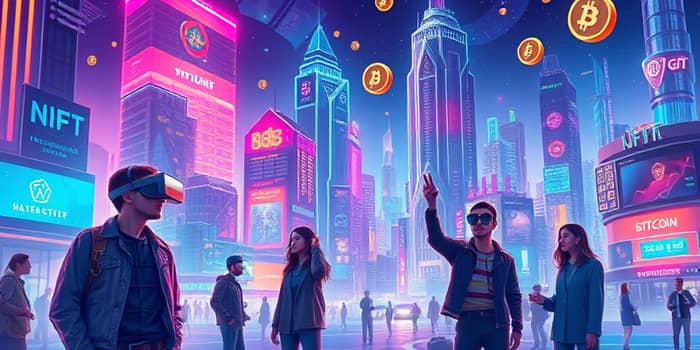
The digital frontier is expanding beyond our screens into immersive virtual realms, unlocking unprecedented opportunities for creators and investors. As the metaverse transforms from a gaming niche into a mainstream economic ecosystem, understanding its driving forces and potential pitfalls is crucial for anyone seeking to ride this technological wave.
Market Landscape and Growth Trajectories
The metaverse market has witnessed explosive growth over the past year. In 2024, estimates placed its value between USD 40 billion and USD 105.4 billion, reflecting diverse methodologies and rapidly evolving definitions. By 2025, forecasts rise further, ranging from USD 32.1 billion in the United States to USD 600 billion globally according to Bloomberg Intelligence.
Looking ahead to 2030, analysts predict values between USD 155 billion and USD 936.6 billion, corresponding to CAGRs exceeding 40%. By 2035, some projections soar above USD 7 trillion, underlining the sheer scale of anticipated expansion.
These numbers are more than mere forecasts; they signal a profound shift in how we work, play, socialize, and invest. With persistent virtual worlds becoming mainstream, early movers stand to benefit greatly from this paradigm shift.
Core Technologies Shaping Virtual Economies
At the heart of the metaverse lies a convergence of powerful technologies:
- Virtual Reality & Augmented Reality: Immersive sensory experiences that blend digital content with the physical world.
- Artificial Intelligence and Machine Learning: Smart NPCs, dynamic world-building, and personalized interactions.
- Blockchain & NFTs: Secure digital ownership and transparent trading of virtual assets.
- 5G and Edge Computing: Ultra-low latency connections enabling real-time collaboration.
These foundational elements drive everything from user engagement to monetization, creating an interconnected infrastructure where digital scarcity and authenticity matter more than ever.
Access technologies are equally vital. Desktop platforms deliver high-fidelity environments, while mobile devices— buoyed by 5G—offer convenience and reach, projected to capture nearly 60% of usage by 2035. Specialized hardware like VR headsets, haptic gloves, and motion sensors further enhance immersion.
Market Segments and Geographic Dynamics
The metaverse economy splits into four broad segments:
- Software and Platforms: Development tools, real-time rendering, and cloud-based environments.
- Hardware and Devices: VR/AR headsets, sensors, haptic gear, and edge servers.
- Services and Consulting: Integration, customization, and enterprise solutions.
- Infrastructure: Networking, data centers, and blockchain networks.
Regionally, North America leads in investment volume and technology leadership, while Europe—particularly the UK and Germany—follows closely with strong growth. The Asia-Pacific region, fueled by its gaming giants and digital innovation, emerges as the fastest-growing market. Even the MENA region exhibits rapid adoption thanks to young demographics and rising internet penetration.
Business Models and Revenue Streams
Monetization in virtual worlds takes many forms, often blending traditional and novel approaches. Key strategies include:
- Experience-based revenues from virtual concerts, product launches, and gaming tournaments.
- Ownership and trade in digital real estate and NFTs, with over USD 2 billion in land transactions recorded in 2024.
- Platform economies charging fees for access, customization, and transaction processing.
- Avatar and content monetization through user-generated goods, virtual fashion, and branded assets.
For businesses, the ability to create recurring subscription and microtransaction models ensures sustainable cash flows, while for users, these models foster deep engagement and community-building.
Industry Applications and Use Cases
The metaverse’s disruptive potential spans virtually every sector:
- Healthcare: Remote surgical training, virtual therapy sessions, and rehabilitation programs.
- Education: Interactive classrooms, virtual campus tours, and immersive skill development.
- Real Estate: Digital property showcases, remote site inspections, and tokenized investments.
- Retail: 3D storefronts, personalized shopping avatars, and virtual try-ons.
- Culture and Media: NFT galleries, live virtual performances, and collaborative art spaces.
Each application underscores how virtual environments can enhance accessibility, reduce costs, and foster creativity in both established and emerging industries.
Key Players and Investment Strategies
Major corporations are staking their claims in this new realm. Meta Platforms invests over USD 10 billion annually in its Reality Labs division. Microsoft’s Mesh platform targets enterprise adoption, bolstered by the Activision Blizzard acquisition. Pixar-like experiences in games come from Roblox and Epic Games, while Unity and NVIDIA build the engines and infrastructure powering these worlds.
Investors can gain exposure through multiple avenues:
- Individual stocks of leading technology firms.
- Specialized ETFs focusing on metaverse and immersive technologies.
- Virtual land purchases and NFT acquisitions.
- Cryptocurrencies native to metaverse platforms.
Constructing a balanced portfolio involves dividing capital across content creators, hardware manufacturers, infrastructure providers, and enabler companies—ensuring diversified exposure across value chains.
Challenges and Future Outlook
Despite its promise, the metaverse faces significant challenges. Regulatory frameworks for virtual taxation, data privacy concerns, and platform interoperability remain unresolved. Market fragmentation poses obstacles to a unified experience, and high hardware costs could slow mass adoption.
Yet, technological advances in cloud gaming, AI-driven content creation, and open standards promise to overcome many hurdles. As enterprises and consumers alike seek more engaging and efficient solutions, those who adapt quickly will thrive.
Embracing the Virtual Frontier
The metaverse is not a distant dream but an emerging reality reshaping how we connect, create, and transact. By understanding its market dynamics, core technologies, and monetization strategies, you can position yourself at the forefront of this transformation.
Whether you are an investor seeking long-term growth in digital ecosystems or a business innovator exploring new customer experiences, the metaverse offers a landscape brimming with potential. Seize the moment, educate yourself, and embark on a journey into these boundless virtual realms.
References
- https://ravespace.io/blog/the-metaverse-in-2025-a-comprehensive-analysis-of-its-technology-economy-and-society
- https://tsginvest.com/emerging-technology/gaming-metaverse/
- https://www.ey.com/en_gl/media/podcasts/tax-law-focus/2022/08/episode-8-how-the-metaverse-economy-will-affect-and-be-affected-by-tax
- https://naga.com/en/academy/metaverse-investment
- https://www.researchnester.com/reports/metaverse-market/3925
- https://www.yudiz.com/insights/metaverse-in-2025/
- https://www.globenewswire.com/news-release/2025/11/14/3188063/28124/en/The-Metaverse-Strategic-Intelligence-Report-2025-A-155-Billion-Market-by-2030-Up-from-40-Billion-in-2024-Driven-by-Advancements-in-Underlying-Technologies-Like-AR-AI-and-Digital-Tw.html
- https://www.solulab.com/top-metaverse-startups/
- https://www.db.com/what-next/digital-disruption/metaverse/investing-investieren/index?language_id=1
- https://www.statista.com/outlook/amo/metaverse/united-states
- https://www.britannica.com/money/what-is-the-metaverse
- https://www.thinkers360.com/tl/blog/members/why-2025-will-be-the-year-your-business-needs-a-metaverse-strategy
- https://www.franklintempleton.lu/our-funds/investment-topics-in-focus/metaverse-a-brand-new-world-of-real-opportunities
- https://www.grandviewresearch.com/horizon/outlook/metaverse-market-size/global
- https://arongroups.co/technical-analyze/best-metaverse-projects/